
Order Total(Inclusive of VAT)



 Proceed to Checkout
Every few months, the interior design world announces a new must-have. A particular shade of green. A sofa silhouette. A material that has apparently never looked better. And every few months, the homes that chased that trend quietly begin to look a little dated. It is one of the more expensive lessons in decorating: following a moment costs more, in the long run, than trusting your instincts.
This is the central question behind any serious furniture buying guide: not what is popular right now, but what will you actually want to live with in five, ten or twenty years? For those who invest in well-made, well-considered furniture, that question has a surprisingly clear answer.
What separates timeless furniture from trend-led pieces
Timeless furniture tends to share a few quiet characteristics. It is rooted in proportion rather than novelty. Its materials are honest and durable. Its silhouette reads as coherent across design periods rather than belonging narrowly to one. And critically, it holds its emotional value over time, which means that as a room evolves around it, the piece continues to earn its place rather than becoming an obstacle to change.
Trend-led furniture, by contrast, is often defined by one very specific quality, a sculptural excess, a saturated colour, an exaggerated detail, that makes it immediately recognisable and, for that same reason, relatively short-lived. It is not that such pieces cannot be beautiful; it is that they demand a particular moment to perform their best. Timeless furniture has no such prerequisite.
This distinction matters particularly when it comes to sustainable furniture choices. Furniture that is bought with longevity in mind reduces the cycle of replacement, which is better both for the home and for the planet. Choosing well, once, is always a more considered approach than cycling through pieces that feel right for a season.
Classic vs modern furniture: A false choice
One of the most persistent myths in the classic vs trendy furniture debate is that you must choose a camp. In reality, the most compelling interiors tend to be those in which the boundaries blur deliberately. A genuinely timeless piece works across periods; it can sit alongside contemporary architecture as comfortably as it does within a more traditional setting. The question is not whether a piece is classic or modern; it is whether it has the structural and aesthetic integrity to transcend the distinction.
Five pieces worth living with
Box stone centre table
Natural stone brings with it a kind of innate permanence. The Box Stone centre table works in high-end interiors because its materiality alone carries the weight of the piece. Stone does not date; it deepens. In a living room that might evolve over many years, new upholstery, new art, new accents, a stone table remains a confident, grounding anchor. This is what long-lasting furniture ideas look like in practice: a piece whose beauty is entirely indifferent to the trend cycle.
Yvette sofa set by Michael Amini
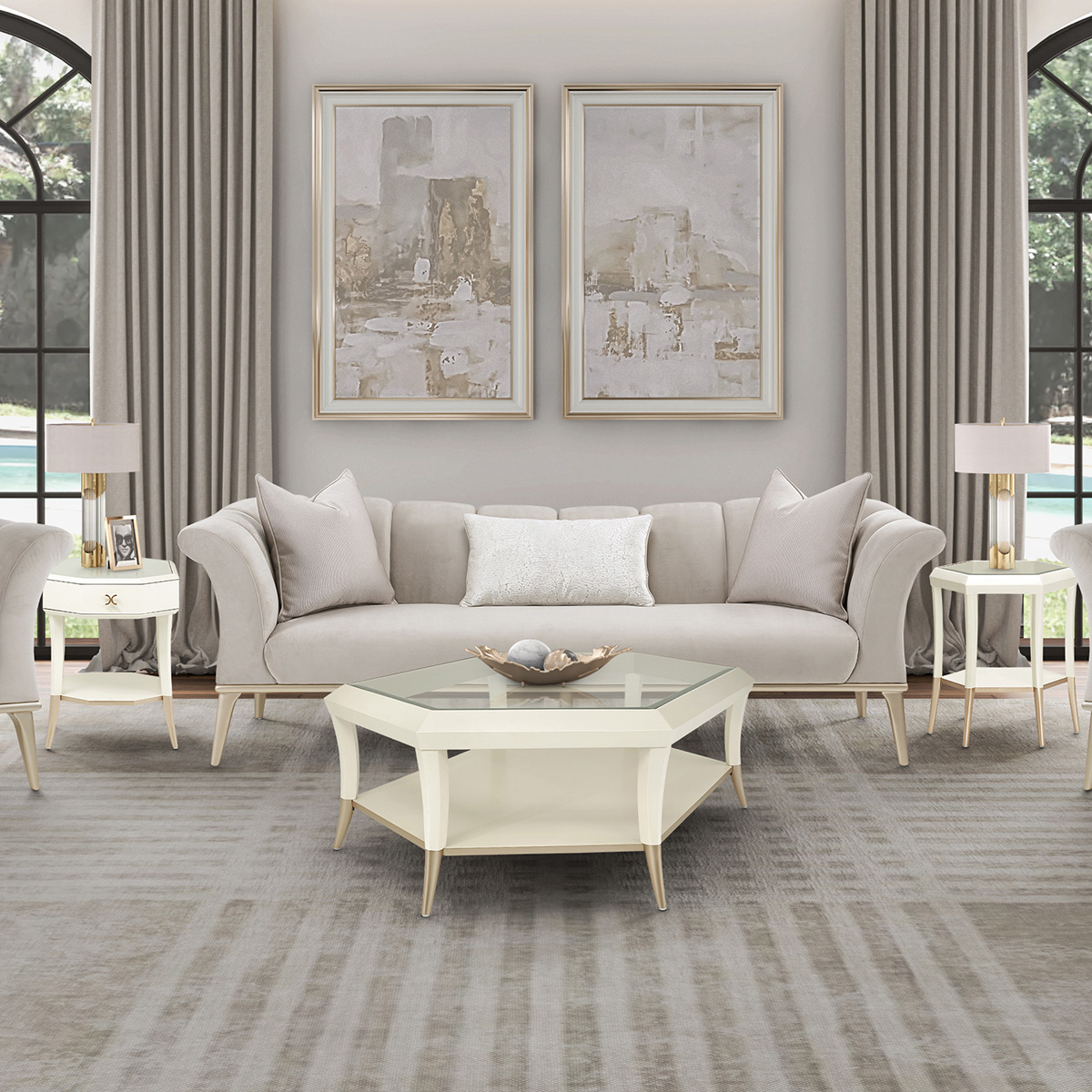
The Yvette sofa set is a compelling example of how to be bold without being transient. Its graceful flared backrest, plush velvet upholstery in chic neutrals and brushed Chardonnay finish are distinctly glamorous, but the glamour is channelled through proportion and texture rather than gimmick. It follows the Michael Amini philosophy of designing with timeless details at the fore and the result is a sofa set that reads as confident and sophisticated rather than of-the-moment. Velvet in a warm neutral is a long-term investment; it photographs beautifully, ages gracefully and works with everything.
Cleo swivel armchair by Bernhardt
The Bernhardt Cleo is a masterclass in the kind of classic vs modern furniture conversation that results in something genuinely versatile. A half-circle sweeps from the back to form the arms, cradling a generous, deep seat that curves into a smooth swivel base. The sculptural quality of the form is balanced by richly textured, nubby upholstery that rewards close inspection. Bernhardt, a company with over 130 years of craft behind it, understands how to build furniture that earns its keep across decades. Cleo's swivel function is not a trend feature; it is a practical intelligence built into a beautiful shell, which is exactly how to choose furniture that will still make sense long after other pieces have been replaced.
Antibes bench by Bernhardt
There is something quietly radical about the Antibes bench. Its arched support panels, formed of glass-reinforced concrete in a subtly pitted Pumice finish, balance a softly upholstered seat with rounded corners. The Antibes collection as a whole is rooted in what Bernhardt describes as organic simplicity: bold monolithic forms that carry a calm, elemental authority. In the context of a considered home, a bench of this character is one of the most sustainable furniture choices you can make. It works at the foot of a bed, in an entryway, along a corridor or in a sitting room and its sculptural confidence means it needs very little around it to succeed.
Loggia console table by Bernhardt
The Loggia console table demonstrates that modern and timeless are not opposites. Its simple lines and gentle curves in wire-brushed oak with an Aria finish are grounded by a travertine stone top, a material combination that speaks to quality in the most direct possible terms. Stone and oak together carry a quiet permanence and the restrained play of convex and concave forms gives the table a considered originality that will not feel dated five years from now. A well-chosen console table is one of the most versatile pieces in any room; this one brings the additional assurance of material longevity.
The real furniture buying guide
Ultimately, the most useful furniture buying guide is not a list of approved styles or approved colours. It is a set of questions worth asking before any significant purchase: Does this piece have a reason to exist beyond its moment? Is it made well enough to last? Will it still feel like an expression of who I am when the trend it belongs to has moved on? And does it earn its place when I imagine the room around it changing?
At Interiors, we carry pieces that pass that test. The difference between a home that feels considered and one that simply feels current is, most often, the quality of those choices.
YOU MAY ALSO BE INTERESTED IN
YOU MAY ALSO BE INTERESTED IN